Fleet insurance is a major but necessary expense for any business operating multiple vehicles. Having protection against liability is critical due to the risk of accidents, theft, and other incidents while vehicles are out on the road, but this can become expensive quickly if you’re not careful. Fortunately, there is a way fleet managers like you can lower their fleet insurance cost while also gaining other benefits.
Using a GPS-based fleet tracking solution like Track Your Truck’s NetTrack platform not only gives you more insight into where your vehicles are at all times, but it also can save you a lot on your insurance. Installing GPS trackers and the associated fleet tracking software platform can result in savings of up to 30% on insurance. This depends on the type of devices installed as well as your insurer. For example, GEICO offers discounts of up to 25% for vehicles with qualified devices, while 21st Century Insurance has offered savings of 15% on comprehensive coverage packages with the use of theft recovery devices.
How much does a tracker reduce your insurance? The amount you save will depend on your insurer, the type of devices you install, whether you integrate them with dashcams, and how much data you share with your provider. Beyond the potential insurance savings, GPS tracking can reduce your costs directly by optimizing fuel consumption, preventing breakdowns, and improving driver behavior. These indirect savings often exceed the direct discounts, especially in fleets of 40 vehicles or fewer where even one prevented claim can offset years of vehicle tracking costs.
When choosing fleet insurance, it’s important to consider what risks are associated with your assets to determine what’s best for your fleet. Before we get into the types of commercial fleet coverage, let’s cover some FAQs you may have about how to choose the right insurance for your company vehicles.
Commercial fleet insurance works similarly to regular auto insurance — covering liability risks regarding theft and accidents. However, there are a few different qualifications. For example, every insurance provider has varying policies and definitions for fleets.
Some insurance companies will require a minimum of two vehicles to provide coverage, while others require at least five. If you’re a small business, you should shop around and see which providers can work with your fleet, especially if you plan to expand your company.
Your fleet insurance cost will depend on a few different factors. Usually, the number of vehicles you need to insure will be the most significant factor.
Insurance companies will also consider the following items:
If your business uses trucks in your fleet, they will also fall into different categories:
Another factor that can influence the cost of your fleet insurance is how comprehensive your policy is, which we’ll get into a bit later. However, if you have a large fleet, you may want the extra coverage to protect your assets in case of accidents. Before you can get an estimate for your insurance, you’ll need to gather some information.
Most major commercial fleet insurers offer some type of telematics-based discount, including GEICO, Progressive, Nationwide, and Allstate. However, the terms of these discounts can vary wildly depending on the company. Some offer explicit anti-theft device discounts, while others offer usage-based insurance programs. In 12 states, including Florida, Illinois, New York, and Texas, insurers are required to offer premium reductions for vehicles that have approved GPS tracking systems.
To qualify for these discounts, fleet managers are typically required to provide proof of active device installation across all vehicles as well as access to relevant driving data, and documentation of a safety management program. Discounts are negotiated directly with the insurer’s commercial underwriting team in most cases. Track Your Truck provides fleet managers with comprehensive data to negotiate discounts as well as satisfy documentation needs.
When shopping around for insurance, you can make the process much simpler and faster if you know what information insurance companies need ahead of time to provide you with a quote. You’ll need some specific details about your company’s vehicles and employees to help answer questions, such as:
Keep in mind that the answers to these questions will affect the price of your premium, so you should be honest to get the most realistic quote for your business. When it comes to your drivers, insurance providers may also ask about their years of experience and driving histories or records to see if any of your employees may pose a risk on the road.
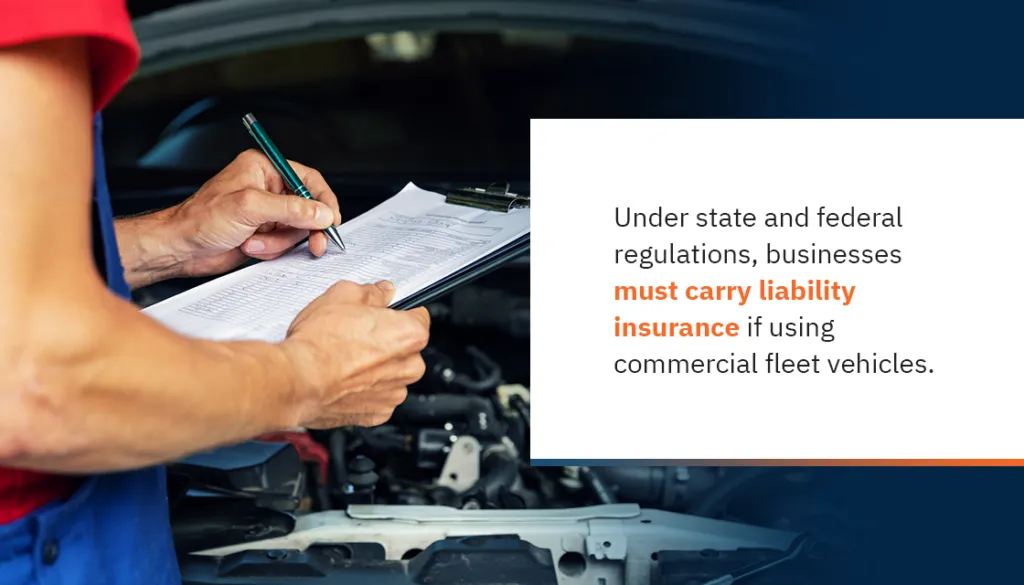
Under state and federal regulations, businesses must carry liability insurance if using commercial fleet vehicles. Liability coverage covers a broad range of situations under property damage, bodily injury or a combination of both. However, the minimum coverage amount varies from state to state. You can check your state’s requirements to ensure your business maintains compliance and avoids penalties regarding insurance.
While the minimum commercial fleet insurance coverage will fulfill your legal requirements, it’s also a good idea to see how you can further protect your assets by adding on additional coverage. Depending on the policy and coverage you choose, your fleet insurance will include collision and liability coverage.
Bodily injury coverage will cover damages and costs if a driver in your fleet is at fault for injuring another person with your company vehicle. Usually, this type of coverage also includes legal defense expenses.
Similar to bodily injury coverage, property damage liability policies will cover legal defense funds and expenses if a vehicle in your fleet damages someone’s personal property.
This type of coverage combines your policies by offering one umbrella limit for property damage and bodily injury claims against your company’s fleet instead of two separate overall limits. You’ll have the same dollar amount coverage limit for any instance that falls within those two categories.
While liability coverage covers you if your drivers cause a car accident, it doesn’t cover damage expenses due to storms, falling trees or flying debris. Physical damage coverage will protect your fleet vehicles from things like vandalism, theft, extreme weather damage and other situations that could harm your vehicle.
Physical damage coverage usually includes collision and comprehensive car insurance that protects against various types of physical damage to your fleet.
Despite the risk, many people on the road are uninsured. If a vehicle in your fleet gets involved in an accident with an uninsured motorist, this coverage option can protect your assets and prevent you from paying for expenses out of pocket, such as medical costs and repairs.
In the U.S., 12.6% of drivers did not have auto insurance in 2019. There’s plenty of risk on the road should one of your drivers get into a collision with an uninsured driver — you’ll have to pay for all the damage. This type of risk can affect your company’s bottom line, so it’s essential to consider this accident coverage.
Finding the right policy and coverage for your fleet is only the first step. Once your vehicles are insured, it’s a good idea to check your policy regularly.
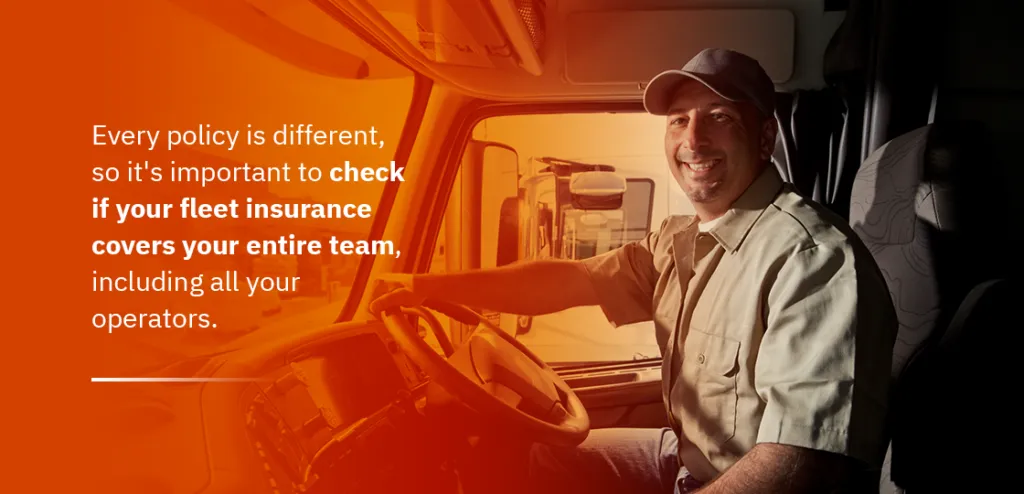
Every policy is different, so it’s important to check if your fleet insurance covers your entire team, including all your operators. Some policies also require you to list every employee who is authorized to operate the vehicles in your fleet, so you should also keep track of everyone on your policy.
Another critical tip is to notify your insurance provider if you have any staff changes, such as new hires. Keep in mind that you will need to renew your fleet insurance monthly, semi-annually or annually, depending on your policy. There are many things to stay on top of when purchasing fleet insurance, and it’s critical that your policy remains valid and protects your assets.
To help manage your insurance and other aspects of your fleet, it’s a good idea to add fleet management and tracking software to help you monitor your vehicles, drivers and insurance. Taking simple precautions with your fleet, such as prioritizing safe driving and training practices and upholding safety standards, can help your drivers remain as safe as possible. These measures can go a long way to help keep your premiums low, so it’s important to:
In addition to maintaining safety practices, you can also look at your policy when you renew it to see what your options are for lowering your premium. Insurance companies certainly prefer safe drivers, so showing your drivers’ records or installing GPS tracking to prove they follow the rules of the road can also positively impact your ability to achieve a lower rate.
If you have mobile employees, insurance is essential to protect your business in the case of claims or accidents. While fleet insurance policies can be more expensive if you have a large fleet with many assets, there are ways you can lower your insurance costs.
Thanks to advanced technology, you can use GPS fleet tracking to keep your premiums low while improving driver safety. GPS fleet tracking is safe and easy to use, and your insurance company may even offer you a discount for adding it. With GPS tracking, you can see where your vehicles are at all times, ensure your drivers know how to find their way and offer them the safest, fastest routes.
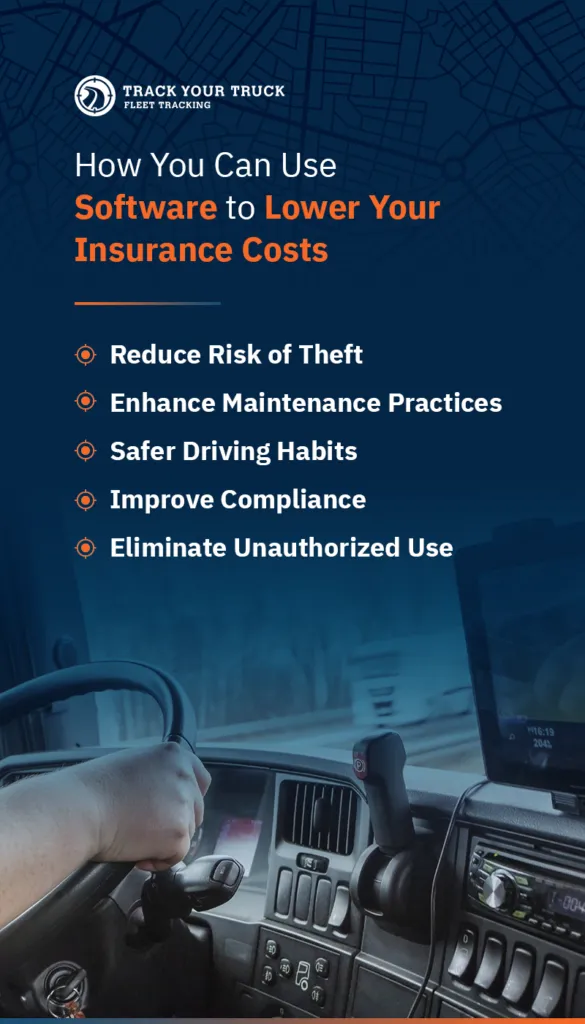
Here are some ways this software can help you lower your insurance costs.
A GPS tracking system can qualify as an anti-theft device in some cases, which can make you eligible for an insurance discount. Demonstrating that you’re responsible with your vehicles and have an added layer of security will benefit you, your drivers and your insurance company. Commercial vehicles, especially those that deliver goods, can be worth thousands of dollars, making them targets for burglars.
In 2019, over 720,00 vehicles were stolen, creating about $6 billion in losses. With GPS fleet tracking, you can monitor your vehicle’s location 24/7 and recover them if they get stolen.
Insurance companies know that well-maintained vehicles are safer and have less risk of wearing or breaking down. If you forego regular maintenance and inspections, you can run into operational issues, failures and even accidents. This type of negligence creates a high risk for your drivers and insurance company.
With GPS monitoring, you can set up real-time alerts to get notified of any inspections coming up for your vehicles or when they need maintenance. GPS tracking allows you to automate your maintenance and provides you with more awareness that decreases your fleet’s risk of breakdowns and accidents, which may help you become eligible for discounts and lower premiums.
GPS tracking encourages safer driving habits, which is vital for keeping your drivers — and others — safe on the road by reducing accidents. Live tracking software also helps you monitor your employees’ hours, mileage, speed, braking and acceleration rates and idle time.
GPS tracking will also provide incentives for your drivers to be at their best behind the wheel when they know they’re being monitored, which can also lower your premiums. Some GPS tracking can even come with dashcam features. In the event of an accident or claim, your driver can pull up the footage to prove they weren’t at fault, which can stop your premiums from rising and costing you more money.
Complying with DOT regulations and maintaining compliance can also lead to savings on your insurance premiums. Using GPS tracking, you can monitor your driver logs, compliance reports and maintenance details to show the safety history of your fleet. In addition, prioritizing safe driving and reducing insurance claims can also help improve your Compliance, Safety and Accountability (CSA) score. CSA scores can influence the price of your insurance premiums, so GPS tracking can help you stay on track.
Your drivers should only use your fleet vehicles for their intended purpose within your business operations. Without GPS tracking, you would never know if your employees are using your company vehicles to take detours while on the job or making personal stops on the way to appointments. With GPS tracking, you can reduce unauthorized use of your fleet vehicles to help lower your insurance premiums.
The key to getting the most benefit out of your GPS tracking system from an insurance perspective is having a successful negotiation with your provider. To start, schedule a meeting with your insurer’s commercial underwriting team and present a complete safety profile. This should include details about the size of your fleet, how long you’ve been tracking vehicles, any improvements in drive behaviors, maintenance compliance records, and any proof of reduced incident rates.
In general, insurers tend to be most responsive to data points such as year-over-year reduction in speeding events, decreased claim frequency and severity, improved vehicle recovery capabilities, maintenance compliance rates, and dashcam footage availability for incident documentation. Whenever possible, make sure to quantify the before-and-after impact of GPS tracking. Track Your Truck’s reporting dashboard makes it easy to pull these figures and present them.
If you have difficulty negotiating with your insurer or aren’t satisfied with the discounts you’re offered, it may be a good idea to shop around for other insurers who do value telematics data. When doing so, ask for examples of premiums with and without GPS tracking so you can see the difference.
At Track Your Truck, we offer the latest technology to provide you with efficient, cost-effective GPS tracking solutions. Implementing the right resources in your company will help you improve safety, monitor your driver’s habits and prioritize vehicle maintenance. We can provide you with the fleet solutions and tools you need, from fleet management software to dashcams to dispatching features.
We want to help your business promote a safer fleet culture and help you avoid costly expenses from damages, theft or collisions. To learn more about the solutions we offer, you can browse our truck tracking products. If you’re ready to see how fleet tracking can help lower your insurance costs, we also invite you to request a quote online.